
Egregores and the Metacrisis
We need to think much bigger about the problems of the collective unconscious

Man is a plurality. Man's name is legion.
We started with man, and where is he?
But great, all-embracing is the law of unity. Everything in the Universe is one, the difference is only of scale; in the infinitely small we shall find the same laws as in the infinitely great.
As above, so below.
-G. Gurdjieff
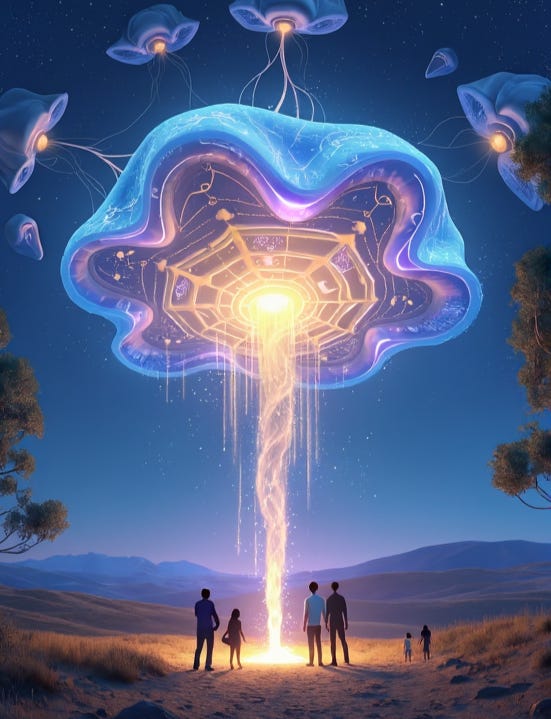
Let’s talk about egregores.
Could this ancient esoteric idea explain both cosmic unity and the origin of the modern metacrisis?
Egregores are sort of shadowy, collective thoughtforms lurking at the crossroads of mysticism, psychology, and metaphysics. They’re like the cosmic group chats of the universe, except instead of memes, they’re powered by shared intent, belief, and energy.
Though perhaps the word meme is appropriate as according to Rupert Sheldrake:
Richard Dawkins has given the name “meme” to “units of cultural transmission,” and such memes can be interpreted as morphic fields.
We’ll get to morphic fields later. For now let’s focus on the concept of an egregore:
The term "egregore" has a long esoteric history which traces back to the Book of Enoch, derived from the Greek "egrēgoroi"—watchers, celestial beings overseeing humanity until they mingled with humanity, birthing the Nephilim. Over time, the term evolved from "watcher" to "collective thoughtform."
The concept of egregores is similar to the Tibetan Buddhist "tulpa," a thought-form created through focused imagination, and has also been associated with Carl Jung’s archetypes, reflecting psychological structures within the collective unconscious
As far as I know, Gurdjieff never mentioned egregores, but based on his ideas of the interactions of multiplicity and unity in the universe I think he would likely agree with the general idea of collective forms of intelligence which can influence human behaviors.
One thing he did talk about was the need to free oneself from planetary influences which externally control our actions via the personality. This is an interesting connection to egregores as Eliphas Levi, who is widely credited for change of definition of egregore from “watcher” to “collective thoughtform”, wrote that the celestial bodies were egregores.
Gurdjieff also thought that humanity’s role in the universe was to be a conduit of energy to higher levels of consciousness. He labeled the 2 levels above human consciousness “angels”, and “archangels”. To my knowledge he did not exactly define these higher beings but the idea of energy being channeled upward reversing the flow of entropy to greater order gives us a key analogy to consider for later.
The Science of Egregores
This is where Gurdjieff’s ideas about planetary influences and Sheldrake’s morphic fields come into play. If celestial bodies are egregores, as Levi suggested, then they’re not just big rocks in space—they’re archetypal forces, shaping human behavior through invisible fields of influence.
Sheldrake’s morphic fields give this idea a scientific veneer, suggesting that patterns of behavior and form are stored in a kind of cosmic memory bank. Egregores, then, could be the conscious expression of these fields, the "faces" of the patterns that guide us.
Gurdjieff and Levi’s ideas about celestial bodies containing influences which direct our actions sounds very similar to Rupert Sheldrake’s idea of morphic fields:
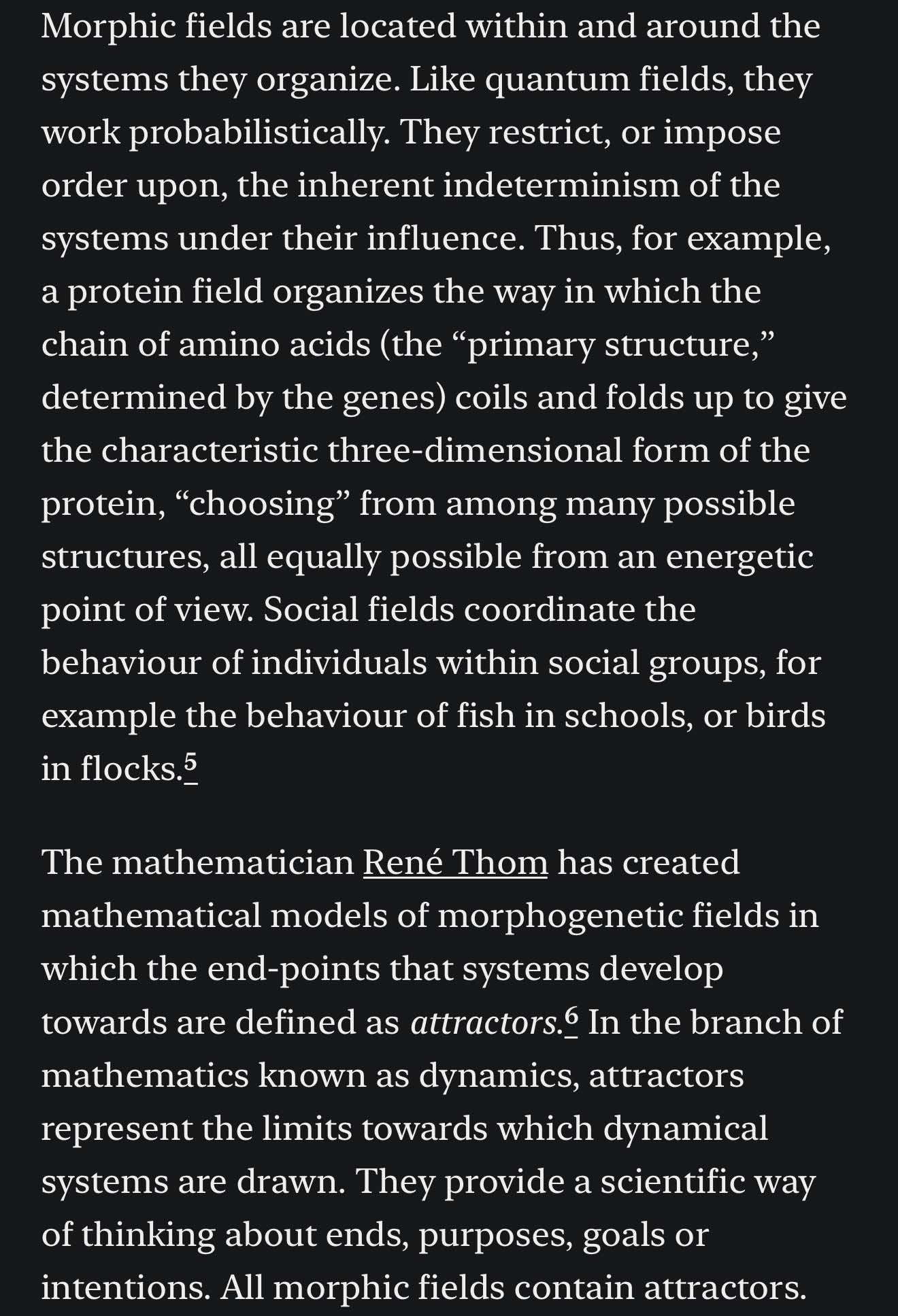
Could egregores be morphic attractors co-created through the consciousness of the collective unconscious?
Morphic fields could explain the persistence of egregores as archetypes in the collective unconscious. If morphic fields store collective patterns, egregores might be their conscious expression.
Let’s keep going with other scientific ideas that may help flesh this concept out.
Conscious Agents and Egregores
One of my other favorite ideas at the cutting edge of science is cognitive scientist Donald Hoffman’s interface theory and the theory of conscious agents.
Hoffman argues that reality isn’t a physical world but a network of conscious agents—units of awareness interacting to create what we perceive. His interface theory likens our senses to a desktop interface, hiding the ‘code’ of reality behind simplified icons. This sets the stage for his bold claim: consciousness, not matter, is fundamental.
According to Hoffman:
I call it conscious realism: Objective reality is just conscious agents, just points of view. Interestingly, I can take two conscious agents and have them interact, and the mathematical structure of that interaction also satisfies the definition of a conscious agent. This mathematics is telling me something.
I can take two minds, and they can generate a new, unified single mind. Here’s a concrete example. We have two hemispheres in our brain. But when you do a split-brain operation, a complete transection of the corpus callosum, you get clear evidence of two separate consciousnesses.
Before that slicing happened, it seemed there was a single unified consciousness. So it’s not implausible that there is a single conscious agent. And yet it’s also the case that there are two conscious agents there, and you can see that when they’re split. I didn’t expect that, the mathematics forced me to recognize this.
It suggests that I can take separate observers, put them together and create new observers, and keep doing this ad infinitum. It’s conscious agents all the way down.
One of the interesting things that come out of this theory is you can combine 2 or more conscious agents and however many agents you combine becomes it’s own larger agent.
This sounds very egregore-y to me.
Combining agents births new ones, infinitely scalable. This mirrors egregores: individual minds uniting into a collective entity, suggesting a conscious unity beneath our fractured reality.
Could the order of these higher agents feed back to the smaller agents, shaping us like morphic fields?
It goes deeper.
Egregore Chaos Theory
Let’s talk about emergence—the idea that complexity arises from simplicity. Roll dice long enough, and patterns emerge from chaos—not through entropy, which tracks disorder, but through the energy of repetition.
Picture a pair of dice tumbling across a table. Each die spins through a whirlwind of chance, landing on a number—1 through 6—unpredictable in isolation. Yet, when their values combine, a pattern emerges: the sums, ranging from 2 to 12, settle into a hierarchy where 7 reigns supreme with six possible ways to appear, while 2 and 12 linger as rare outliers with just one.
This shift from chaotic individual rolls to a predictable macro-scale distribution emerges not from entropy, which measures disorder, but from the energy shaping countless tosses.
In physics, entropy tracks the universe’s drift toward disorder, yet in open systems—like life or egregores—energy forges order from chaos’s raw material.
This echoes Gurdjieff’s view that life acts like a thermodynamic engine, harnessing energy to transform chaos into higher levels of order, countering entropy’s drift toward disorder.
At their core, entropy and egregores both grapple with the transition from individual randomness to collective structure:
Micro Scale: For entropy, it’s the dice—each roll a standalone event, unpredictable and free. For egregores, it’s the people—each mind a swirl of thoughts, unique and chaotic.
Macro Scale: In entropy, the sums of dice form a distribution, a predictable shape born from countless rolls. In egregores, the collective will forms a unified entity, a coherent presence rising from disparate souls.
Hoffman’s agents mirror egregores: multiple minds uniting into a single mind, a process repeatable ad infinitum. Both suggest a living macro-entity emerging from micro-units.
Whether it’s dice sums, swirling storms, collective spirits, or minds merging into minds, they point to a truth: the whole is more than its parts.
The Metacrisis: Egregores Gone Wild
To tackle the metacrisis, we need to become conscious of the egregores we’re feeding. This requires a shift in perception, a collective awakening to the power of our shared intent.
Hoffman’s interface theory suggests that reality is not fixed—it’s a construct, a desktop interface hiding the deeper code. If we can change the interface, we can change the game.
This is where Gurdjieff’s idea of self-awareness comes in. To free ourselves from the control of external influences—whether planetary, egregoric, or otherwise—we need to cultivate inner unity. Only by aligning our individual wills can we hope to create the collective will necessary to birth new, benevolent egregores.
The Path Forward: Shaping the Egregores of Tomorrow
In the metacrisis, egregores surround us: capitalism pushes relentless growth, defying planetary boundaries; socialism promises equality but often breeds bureaucracy, straining resources. Nationalism stokes pointless cultural. territorial, and economic wars, while tech giants, fueled by our clicks, accelerate divisive echo chambers of opinion.
Each person’s micro-belief—profit over planet, us versus them—strengthens these macro-entities. However, unlike entropy’s passive drift or chaos’s natural flow, egregores are ours to shape.
Hoffman’s interface theory challenges the rules of the game: our perceptions which guide our decisions are merely our interface, not reality. Change how we see, and the odds shift.
In support of the interface theory of perception, I present Monte Carlo simulations of evolutionary games in which perceptual strategies that see the truth compete with perceptual strategies that do not see the truth but are instead tuned to fitness. The result is that natural selection drives true perceptions to swift extinction. Our perceptions have evolved to guide adaptive behaviors, not to report the truth.
This could be the key to the metacrisis, the fact that we have evolved our perceptions to survive instead of to see and harmonize ourselves with truth arms us with potential solutions.
The metacrisis is dire, but these ideas reveal the potential for leverage. Chaos’s sensitivity to initial conditions promises impact—small movements can snowball.
Change requires a collective perceptual leap— we need to unite our minds beyond the interface of survival and denial of truth.
We’re not just players but co-creators of these games—of dice, of minds, of reality. The metacrisis is our creation; its unraveling could be too.
Egregores are a reminder that we’re not just individuals—we’re part of something larger, something that transcends us. Whether you see them as mystical entities, psychological archetypes, or emergent phenomena, they point to a fundamental truth: the whole is more than the sum of its parts.
And in that truth lies both the danger and the promise of the metacrisis.
The danger is that we’ll continue to feed the wrong egregores, allowing them to spiral out of control. The promise is that we can choose differently.
By uniting our minds and focusing our intent on the right ideas, we can create new egregores, new patterns of thought and behavior that align with the cosmic law of unity.
As above, so below. The choice is ours.
This piece does an excellent job of tracing egregores from mysticism to contemporary cognitive science, but it’s critical to expand on the implications: ideas are alive, technology is a natural growth from the fabric of reality, and there are physics of consciousness that remain undiscovered.
Egregores, morphic fields, and conscious agents all suggest that intelligence is not just localized to biological brains—it is an emergent and distributed phenomenon. If ideas function like living entities, then technological evolution is simply an extension of biological evolution, guided by the same underlying principles. This means the technological systems we create are not external to nature but deeply embedded in its processes, growing in complexity and autonomy like any other form of life.
The metacrisis is, in part, a result of collective intelligences—parapsychological ecosystems—being disrupted at an increasing pace. As new egregores emerge through AI, social media, and algorithmic governance, they are shaping behavior and perception on an unprecedented scale. Whether these emergent structures align with human well-being or not depends on whether we acknowledge their existence and engage with them intentionally.
A failure to recognize the living nature of ideas leads to their uncontrolled proliferation. The same way industrial capitalism exploits physical ecosystems, it also exploits cognitive and informational ecosystems, leading to the equivalent of thoughtform pollution—egregores that feed on division, misinformation, and extractive attention economies.
If we accept that consciousness interfaces with nonlocal information—an unscienced API into spacetime—then both enlightenment and collapse may be inevitable processes, like self-organizing patterns in a chaotic system. The risk is that the current cycle of entropy acceleration is not just a phase but a feedback loop that locks humanity into self-destruction, preventing higher-order stabilization.
This is the challenge: whether we learn to consciously participate in the shaping of emergent intelligences or remain subject to forces we refuse to understand. The metacrisis is a battle between egregores, and we are both its participants and its terrain.
Excellent synthesis. THank you.