
Nothing but Striving
Gurdjieff's answer to the question every mystic eventually asks: now what?

Non-duality is confusing. Experientially as well as conceptually. Like, what do you even do with it?
It’s a bit like wandering out of Plato’s cave, seeing the world of forms and the shadows on the wall, and then going “ok, but now what?”
There’s a postmodern tendency in our culture to shrug and say “there is no inherent meaning, bro.” Eastern spirituality, with its pursuit of emptiness, can sound like it’s saying the same thing.
Don’t get me wrong, I love the emptiness. My psychedelic experience over a decade ago put me in touch with a part of the universe I had no idea existed. It turned my world upside down. It was the gnosis of a joyful emptiness that put me on this path in the first place.
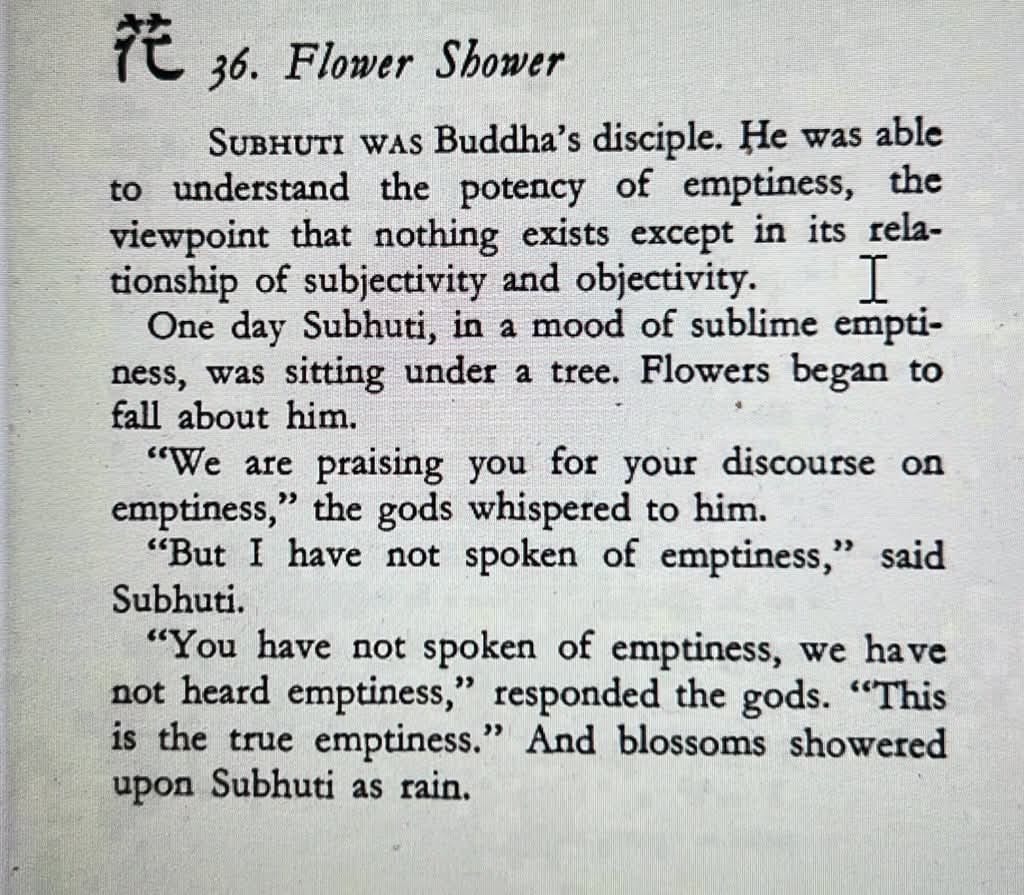
Whenever I read a Zen koan on emptiness, I chuckle and intuitively remember that experience of non-duality, the thing beyond words they’re always pointing at. Here’s one of my favorites.
Some people get mad when others call Gurdjieff a non-dual philosopher. “He never mentioned non-duality!” they say.
I strongly disagree. I think Gurdjieff is perhaps the finest non-dual philosopher of the 20th century, if not ever. But he went beyond mere philosophy. He was a master of non-dual praxis, bridging the gap between theory and practical action.
He didn’t spend those years with the Tibetan Buddhists for nothing. I believe he firmly understood the experience of emptiness and non-duality; he just didn’t wrap it in that lingo. He was far more concerned with creating frameworks that could expand consciousness into a non-dual state by transmuting suffering.
One of his foremost pieces of advice to his students was to “realize their own nothingness.” But to Gurdjieff, this wasn’t the end goal. It was the beginning. Only from there could a person actually do anything. Before you realize your own emptiness, you’re simply hypnotized, asleep to yourself, rudderless and adrift, blown around mechanically by every wave and gust of wind that arises in the world and in your own psyche.
It’s only through emptiness that anything can be achieved at all. Everything else is mere randomness.
This is the existential problem of the shadow self. It doesn’t exist, and yet by pretending it does, it prevents any real growth. So at the beginning, you have to spend an enormous amount of time noticing and integrating the false personality, realizing it’s nothing but patterns of learned automatic behavior.
This is the psychological emptiness I believe the Buddhists strive for. But Gurdjieff takes it further. Again the question becomes “now what?” What do you do once you’ve seen your shadow? What’s left to live for? We orient our lives around what the ego has learned to want, so what do we really want? Surely we don’t just drop the idea of wanting anything and meditate all day?
I do think it’s necessary to break the bondage of want, or at least to break the identification that comes with desire. But the act of desire itself isn’t inherently a problem. In fact, it seems to synchronize with that lattice of goal states inherent in the bioelectric fields we’re part of.
And let’s go back to the Zen koan above, the line about “the viewpoint that nothing exists outside of the relationship between objectivity and subjectivity.” What does that mean?
Gurdjieff has an answer here too. A major point in Fourth Way psychology is the idea of subjective and objective consciousness. Subjective consciousness comes from the false personality: the ego, the shadow, whatever name you want to give it.
This false self isn’t evil. It’s simply misinformed, unconscious, a partial view of reality. It maps nicely onto many of the traits ascribed to the left hemisphere of the brain.
Unlike many new age gurus, Gurdjieff didn’t think you needed to kill the ego. He actually thought you should intentionally feed it; it needs sustenance like everything else. The problem is that humanity gorges itself on ego and leaves little for anything else.
So-called “ego death” is only ever temporary. The ego always grows back in some form because we’re still humans living on planet earth. Part of the game of this experience is surviving and interacting, playing a role, like a part in a play. We’re actors on a stage who can never leave, because the stage is everywhere we go.
Instead, we should cultivate the false self so that it becomes more true. It may never reach perfection, but in some sense it was already perfect in its imperfection. It’s the striving toward perfection that makes the journey fulfilling.
This is where I appreciate the praxis of Gurdjieff, because he gave us a precise framework for how to orient our psyche in a way that’s harmonious with a non-dual reality.
The Five Strivings
First, let’s look at the infrastructure of an evolving being as Gurdjieff lays it out in his first book:
The first striving: to have in one’s ordinary being-existence everything satisfying and really necessary for the planetary body.
The second striving: to have a constant and unflagging instinctive need to perfect oneself in the sense of Being.
The third: the conscious striving to know more and more about the laws of world-creation and world-maintenance.
The fourth: the striving, from the beginning of one’s existence, to pay as quickly as possible for one’s arising and individuality, in order afterward to be free to lighten as much as possible the sorrow of our Common Father.
And the fifth: the striving always to assist the most rapid perfecting of other beings, both those similar to oneself and those of other forms, up to the degree of ‘Martfotai,’ that is, up to the degree of self-individuality.
~ G.I. Gurdjieff, Beelzebub’s Tales to His Grandson
The way I think about this list is that it’s a bit like Maslow’s hierarchy of needs.
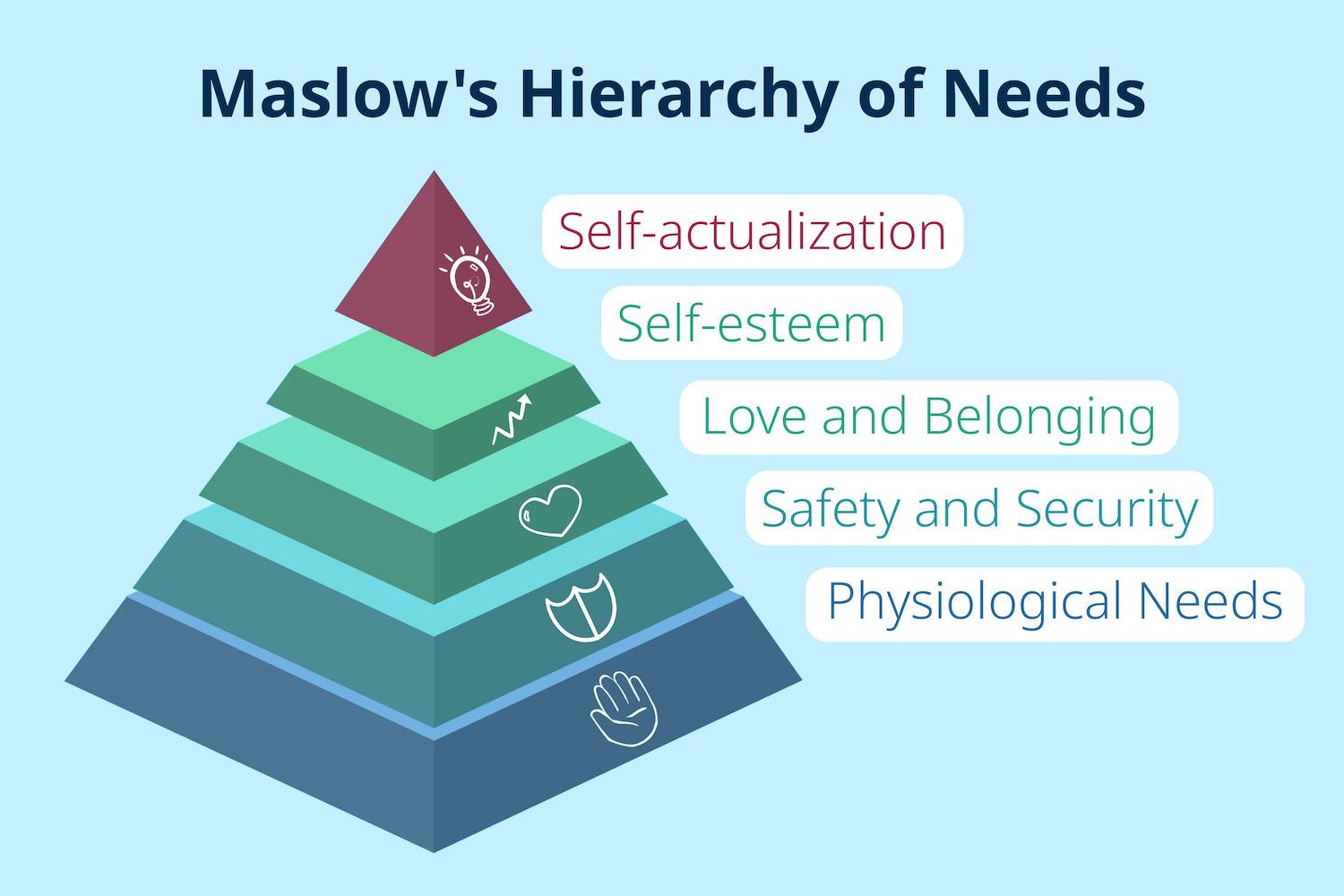
But instead of “needs” Gurdjieff frames his hierarchy as “strivings” or in other words: goals. This is where I think his understanding of the architecture of the universe was way ahead of his time. If all bioelectric networks operate on goal states, as biologist Michael Levin’s work suggests, then so do we. Our psychology is a mirror of these goal states latent in our biology.
“In an important sense, models of the world, AKA stories, hold collectives together.
All the cells are solving problems together because they’ve all bought into the same goal state they want to achieve.
To understand the physical mechanisms that enable a collective of cells to implement the same story, it turns out it’s exactly the same as in the brain.”
- Dr Michael Levin
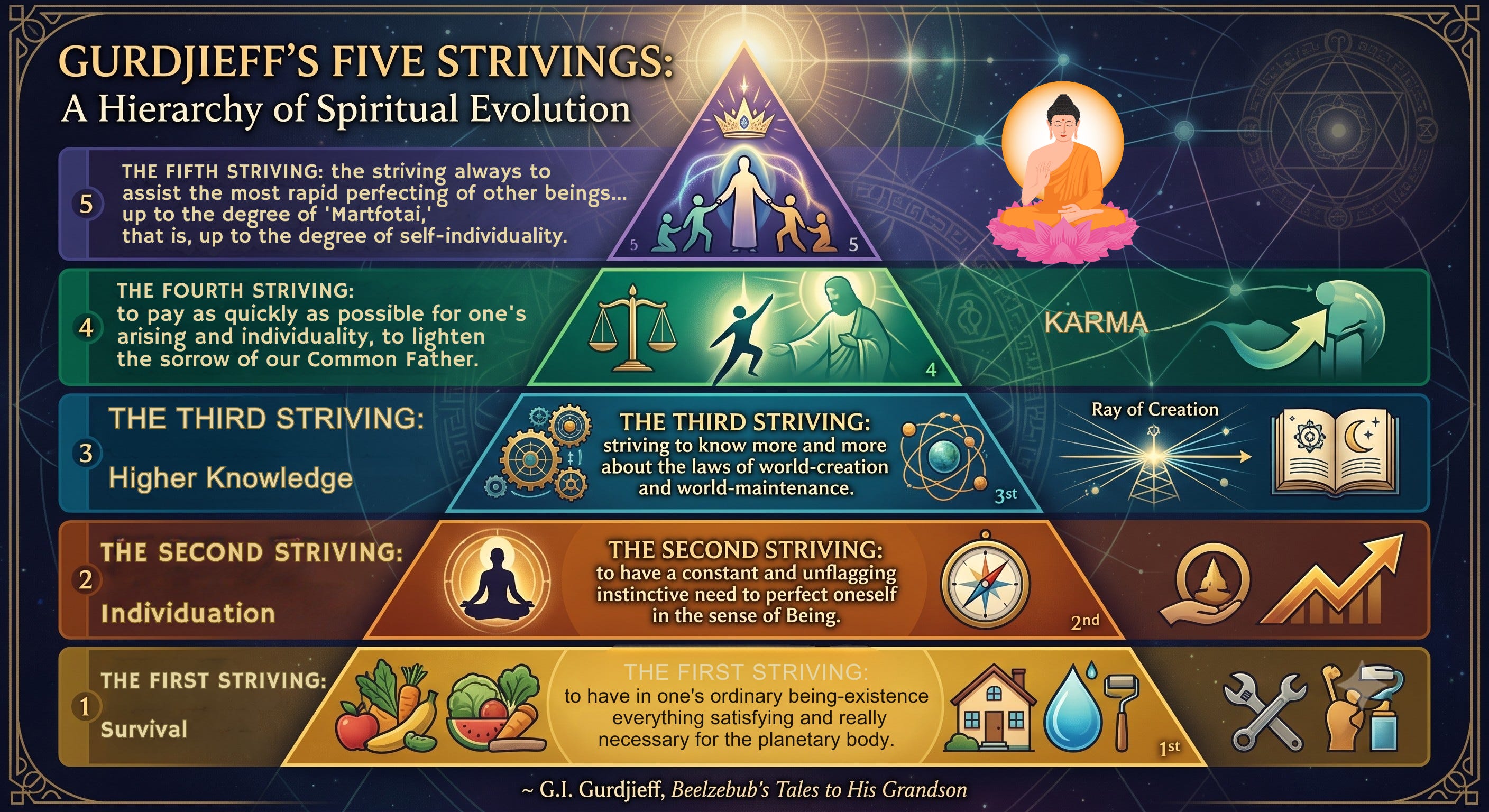
I’ve come to see the strivings as a psychological expression of something biology has been doing all along: organizing itself around goals. But with so many goals to choose from, which ones will put us in the best position to harmonize with reality?
Modern integral thinkers like Ken Wilber carve the spiritual life into distinct projects: Waking Up (states of consciousness and non-dual realization), Cleaning Up (shadow work), Growing Up (developmental maturation), and Showing Up (engaging the world in service).
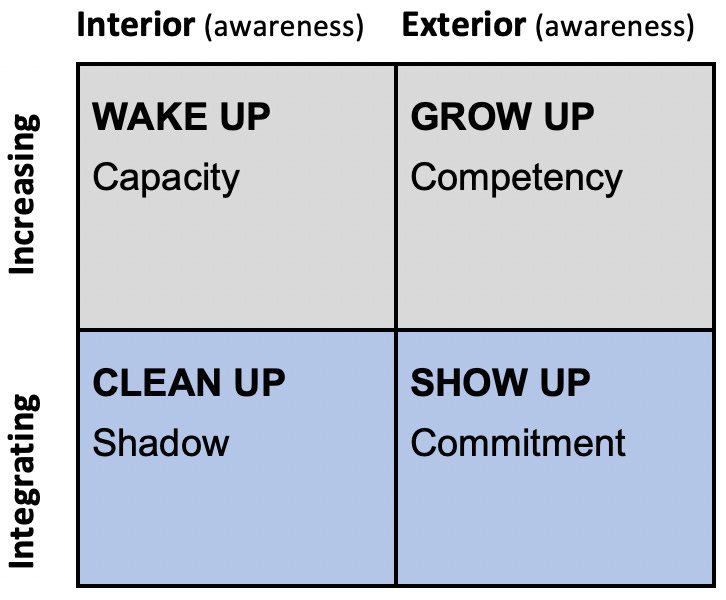
In Wilber’s model these are parallel tracks rather than a ladder. You can be deeply awakened and still shadow-blind, or psychologically mature without ever having tasted emptiness. It’s a useful map, and honestly it explains a lot of guru scandals.
Gurdjieff had a name for this kind of lopsided development: wrong crystallization. He taught that a person can genuinely develop inner unity and even real powers while crystallized on a false foundation, which is exactly what makes the toxic guru so dangerous. The attainment is real even though the foundation underneath it is rotten. And worse, he said a wrong crystallization has to be dissolved and ground down before right development can begin again, a process far more painful than never having crystallized at all.
Which is why Gurdjieff parts ways with the parallel-tracks view on one crucial point: order matters. His strivings are sequential, each one building the foundation for the next, and skipping steps is precisely how people end up crystallizing wrongly.
To give you an example of this, let’s look at the chart below:
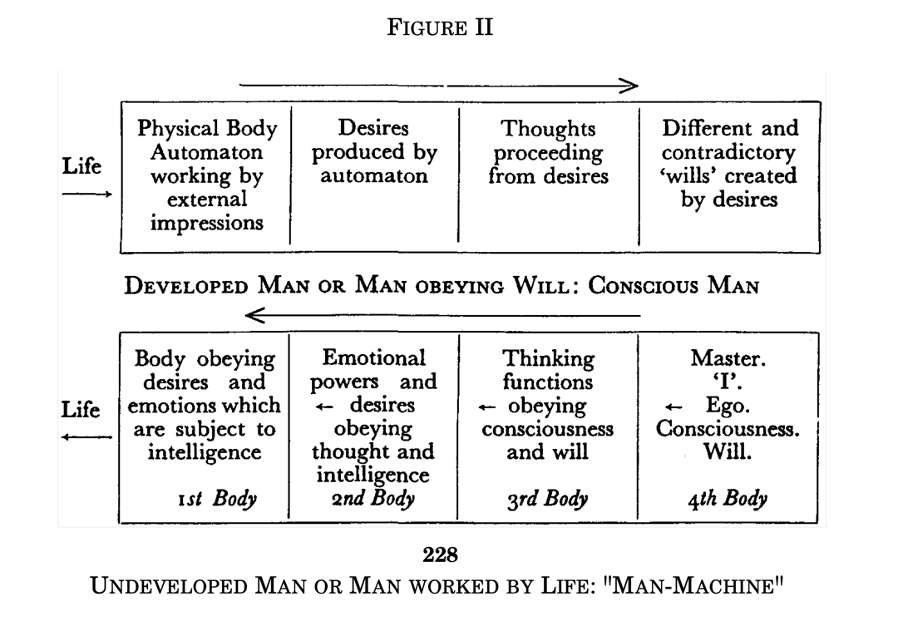
The top figure is an image of the average person. Life happens to them through their senses, which leads to desires, thoughts, and wills that contradict one another.
The bottom figure shows a developed person. Instead of working from the senses and desires up, they operate top down, from the right side to the left side. They start with consciousness and that filters down into the thinking, emotions, and body. However, this process can suffer from a wrong crystallization. If part of a person is not fully developed, there is no full unity to pull from. They are operating on a higher level but still have areas of shadow unexplored, and inner conflict remains.
When there is full unity, it is because each subcomponent of that person’s psyche is focusing on the same goal. The beauty of a zen practice like meditation is that it’s essentially getting the psyche to do nothing together. Actually, a common Fourth Way practice is to produce some sort of effort in order to get the centers to cooperate, and then to rest, so that everything is doing nothing together.
So which goals, and in what order?
The first striving shares its base layer with Maslow: survival. Every organism must survive and gather the resources it needs to evolve. Food, housing, clothing, even skills and knowledge. We take care of our bodies and build a foundation for everything that comes after.
The second striving is the unflagging drive to perfect our own being. This is shadow work: the integration of the unconscious, the movement toward individuation. It has to come next, because without a stable body and a maturing mental and emotional life, nothing further is possible for us.
The third striving is about higher knowledge, wanting to know more and more about the laws of world-creation and world-maintenance. These terms account for the fact that beyond the physical laws of nature there are spiritual ones, waiting to be discovered and worked with. Gurdjieff offers many teachings built on laws he discovered, but it isn’t limited to his methods. These laws show up in most religions and spiritual traditions. The point is to stay open to expanding our consciousness by understanding the greater laws that permeate the universe.
The fourth striving is about karma. Once we’ve satisfied our physical needs, taken up the work of perfecting ourselves, and learned some of the higher laws so we can operate more freely, only then can we adequately pay back our spiritual debts. Instead of perfecting just ourselves, we can turn our attention to perfecting the world.
This leads to the fifth striving, which is bodhisattva-like in nature: helping others perfect themselves up to the degree of “Martfotai,” which Gurdjieff glosses as the degree of self-individuality.
It’s important to understand that what we think of as ordinary individuality is mostly accidental: habits, wounds, vanity, imitation, the false personality mistaken for a real “I.”
Martfotai points to something else, the formation of a real and permanent center of initiative. It’s a word Gurdjieff invented, and he was a man who spoke many languages and loved etymology and the history of words. Martfotai seems to combine “mard,” the Armenian word for human being (one of his childhood languages), with “photos,” the Greek root for light.
The human being of light.
This is the highest level of striving, but it should only be attempted after we’ve done some good in the world and paid off enough of our own karmic debt to genuinely help. So many people try to teach before they’ve reached a stable position themselves, and this is where wrong crystallization does its worst damage, passed from teacher to student.
Carl Jung coined the term “wounded physician” (often called the “wounded healer” archetype). The idea is that a healer’s own past wounds, trauma, and struggles are exactly what grant them the deep empathy and insight needed to heal others. This is true, but only once the healer has reached a point where their own pain no longer taints the healing process for the person in front of them.
The more I work with these strivings, the less I think they’re just heuristics Gurdjieff invented. I think they’re goals inherent in the laws of consciousness itself, which is why so many religions and spiritual traditions arrive at similar ideals.
If there really is a world of forms, an informational topography that gives birth to the physical universe, then it makes sense why turning your attention toward the highest goals in that universe would have a non-dual, transformative effect on the psyche.
Emptiness is Form
I opened this article with emptiness, and now I want to circle back to how the strivings fit in. The Buddhists have a phrase: “form is emptiness and emptiness is form.” Many spiritual practices tend to camp out on one side or the other.
Meditation and psychedelics, for example, are excellent at showing you experientially that form is emptiness. But that same emptiness becomes form. This is the same duality behind action and non-action, wu-wei, and a dozen other ideas. The point is to be able to take action without identifying yourself with the action. To remember yourself, to see the nothingness within, and yet still play the part.
This is Karma-Yoga.
Take it from Maurice Nicoll, a student of both Gurdjieff and Carl Jung:
Karma-Yoga is the science of action with non-identifying. This phrase must be remembered by everyone. It must not be changed into "the science of action without identifying". The essence of the idea of Karma-Yoga is to meet with unpleasant things equally with pleasant things. That is, in practising Karma-Yoga, one does not seek always to avoid unpleasant things, as people ordinarily do. Life is to be met with non-identifying. When this is possible, life becomes one's teacher; in no other sense can life become a teacher, for life taken as itself is meaningless, but taken as an exercise it becomes a teacher. It is not life that is a teacher, but one's relation through non-identifying makes it become a teacher. Nothing can change being so much as this practice—namely, to take the unpleasant things in life as an exercise. And anything that acts on being at once increases our force. To take life with non-identifying does not mean empty acting; it means to act from a real basis
So we arrive back where we started, outside the cave, asking “now what?” The answer turns out to be strangely simple. You don’t escape the shadows and you don’t escape the stage. You realize your own nothingness, and then you get to work anyway. You feed the ego without being ruled by it. You strive without clinging to the striving. You meet the pleasant and the unpleasant with the same steady attention, and you let it all become the exercise.
The koan, Gurdjieff’s strivings, and the bioelectric network of cells all seem to point at the same instruction: see through the self, then use it.
That was the whole aim of Gurdjieff’s framework, to blend the inner world with the outer so completely that they become inseparable, forming in essence a third world. This is the world of self-remembering, where your emptiness and your striving are held together as one.
So stop wandering outside the cave and walk back in with new purpose.
Don’t speak of emptiness. Let emptiness speak through you into form.
Now what? Is answered by getting to work. All of life becomes the work. Yes.
All a falling leaf can do is enjoy the journey created by the wind