
Wisdom, Intelligence, and Thermodynamics
Intelligence Solves Problems, but Wisdom Sustains the Universe.

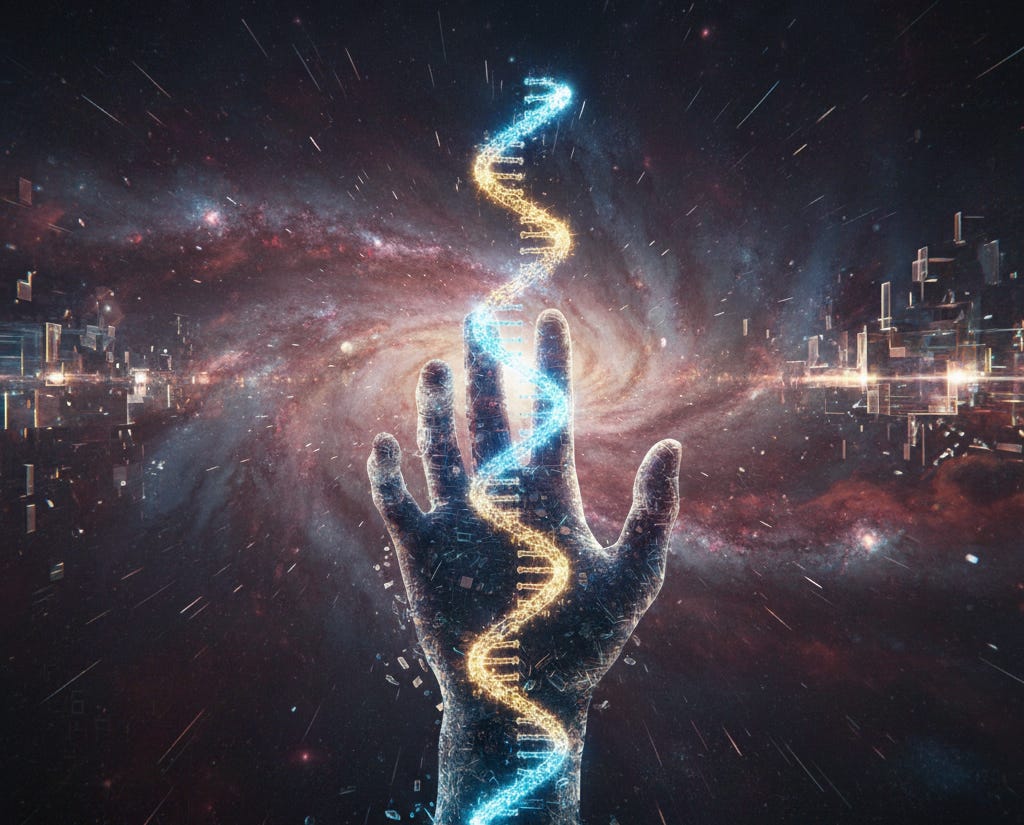
The Cosmic Struggle Against Decay
As we allegedly accelerate into the singularity, I think it’s time to take a deep dive into what intelligence really is, artificial or otherwise. What is the difference between wisdom and intelligence and what agency does humanity have in a thermodynamic universe?
In my last article, I explored how the idea of God could be viewed through a thermodynamic lens. In Gurdjieff’s cosmology God is essentially a cosmic entity locked in struggle against entropy and time. An interesting intuition which corresponds to the idea of the thermodynamic arrow of time in science, where it is theorized that entropy directs the arrow of time. It is why the past (ordered) looks different from the future (disordered).
Gurdjieff had 2 laws that governed his thermodynamic cosmology: the law of falling, and the law of rising.
The law of falling is the process of entropy through time. Energy descends, things fall to their natural level. The law of rising is that energy climbing back up the chain, it is a law of transmutation, or as a scientist might call it: negentropy.
Negentropy and the Alchemy of Life
Negentropy is a measure of the order, structure, and information within a system, effectively the opposite of chaos. A living cell doesn’t just eat food for energy; it eats food to import order.
It turns out that energy, negentropy/entropy, and information are vital aspects to the understanding of intelligence.
Let’s look at this idea through the lens of the laws of rising/falling: energy from the sun (highly ordered light) falls from the heavens to the earth. This light gives off heat, which is highly entropic energy, however some of it lands on plants, who use the highly ordered structure of light energy for food.
The plants use this highly ordered energy not just for fuel, but to bring more order to their own organism while exporting entropy as waste and heat. Animals eat the plants, taking the order up the chains, humans eat plants and animals (a lot of time adding heat, another type of energy adding order) sending it up another level. The law of falling sent the ordered energy down via the sun, we return energy back up the chain through making ourselves more ordered.
Ok all good so far, but what does this have to do with information and intelligence?
It all has to do with negentropy. Negentropy, remember is the law of rising, of energy becoming more ordered rather than entropic. Without a source of negentropy (like the Sun), the “Arrow of Time” would quickly lead every system to a state of stagnant, grey equilibrium.
The Second Law of Infodynamics
In the 1950s, physicist Léon Brillouin extended the idea of Negentropy to Information Theory. He realized that information is a form of negentropy.
Why? It turns out: Entropy = Uncertainty: If you don’t know the state of a system, its entropy is high.
Meanwhile, Negentropy = Knowledge: When you gain information about a system, you reduce its entropy.
But physicist Melvin Vopson took this further. If information is negentropy, he reasoned, then information systems should still tend toward disorder over time, just more slowly. When he tested this, the opposite happened. Entropy in information systems remains constant or even decreases to a minimum value at equilibrium.
Information doesn’t just slow entropy. It reverses it.
Vopson proposed that information is a "fifth state of matter", a seemingly radical theory which surprisingly received little push back from the scientific community he once pointed out.
He argues that while physical entropy is always rising, "information entropy" balances the books. Matter tends toward chaos; information tends toward order.
“We know the universe is expanding without the loss or gain of heat, which requires the total entropy of the universe to be constant,” Vopson wrote. “However we also know from thermodynamics that entropy is always rising. I argue this shows that there must be another entropy, information entropy, to balance the increase.”
If information has mass, it could even solve the mystery of dark matter but that is a story for another time.
Intelligence as a Thermodynamic Necessity
If Vopson is right, the universe balances its books through information. If information is the currency of order, then intelligence is the 'investor' that puts that currency to work.
Matter decays. Information orders. Intelligence is the harvester.
This is the core of the Free Energy Principle (FEP), primarily developed by neuroscientist Karl Friston. According to this view, intelligence isn’t just a feature of certain brains; it is a thermodynamic necessity for any system that wants to survive in an unpredictable universe.
Think of it this way: negentropy is the universe’s capacity for order, information is how that order gets encoded and preserved, and intelligence is the active work of harvesting that order before the void takes it back.
In physics, a system “in equilibrium” with its environment is essentially dead (like a rock). Living systems must stay “out of equilibrium” by resisting entropy. However, this supposed duality between “living” and “dead” matter may simply be one of scale. As Michael Levin points out, even supposedly dead matter shows signs of learning and intelligence at smaller scales. He frequently calls this “just physics” (in quotes) because the boundary between living and non-living may be more gradient than binary.
Friston argues that living systems resist entropy by minimizing “surprise” (mathematically known as variational free energy). Intelligence is effectively the efficiency of this process.
Think of entropy like a messy desk. Physical entropy is like a desk with the papers scattered everywhere. Negentropy (order) is the filing system that allows you to find what you need.
So, what does an intelligent system actually do?
At its core, it’s an expert at compression. It sifts through the ‘noise’ of the world, distilling massive piles of chaotic data into simple, usable laws. But the real magic isn’t just in recording the past, it’s in stalking future uncertainty.
This is the mathematical heartbeat of curiosity. We don’t just wander into the woods for the scenery; we do it because a blank spot on the map is a high-entropy liability. That isn’t to say a beautiful view is ‘useless’, on the contrary, the awe and fulfillment we feel in nature can be a potent source of negentropy, a way of ordering our internal chaos. But we also explore because we must. In a universe governed by decay, ‘staying curious’ is the only way to keep our long-term stability from collapsing into the void.
Perhaps that is why earth is considered a school in many mystical systems, because we are here to learn, to collect information (negentropy) both spiritually and thermodynamically.
Beyond Fruit Salad
William James had a great quote, he said that intelligence is a fixed goal with variable means of achieving it. In other words, what type of obstacles can this system overcome to achieve its goal? Remember the thermodynamic goal of any system is to reduce entropy, or increase its overall negentropy.
So the ability for a system to select goals that maximize it’s own negentropy is something of epistemic value to that system.
I am reminded of the common saying Intelligence is knowing that a tomato is a fruit. Wisdom is knowing not to put it in a fruit salad.
In other words: intelligence solves the puzzle; wisdom decides which puzzle is worth solving.
A famous puzzle in philosophy (dating back to Plato’s Meno) asks: Why is knowledge more valuable than a lucky guess?
If you want to get to a specific city, a lucky guess about which road to take gets you there just as fast as knowing the way. However, philosophers argue that knowledge has higher epistemic value because it is “tethered” to the truth. A lucky guess might work once, but knowledge is reliable, stable, and allows you to explain the path to others.
Wisdom is knowledge on a broader scale. It doesn't just ask how to get there, but what to bring, when to leave, and why the journey matters. It connects multiple layers of knowledge into a common goal.
How could we determine if our choices are wise? One way to look at it might be, does this goal increase my negentropy? Does it benefit my life in some way? Materially, emotionally, spiritually, etc.?
What about others? Does this goal affect the negentropy of my family? My community? My world? My solar system? My body? etc, etc, etc.
Expanding the Cognitive Light Cone
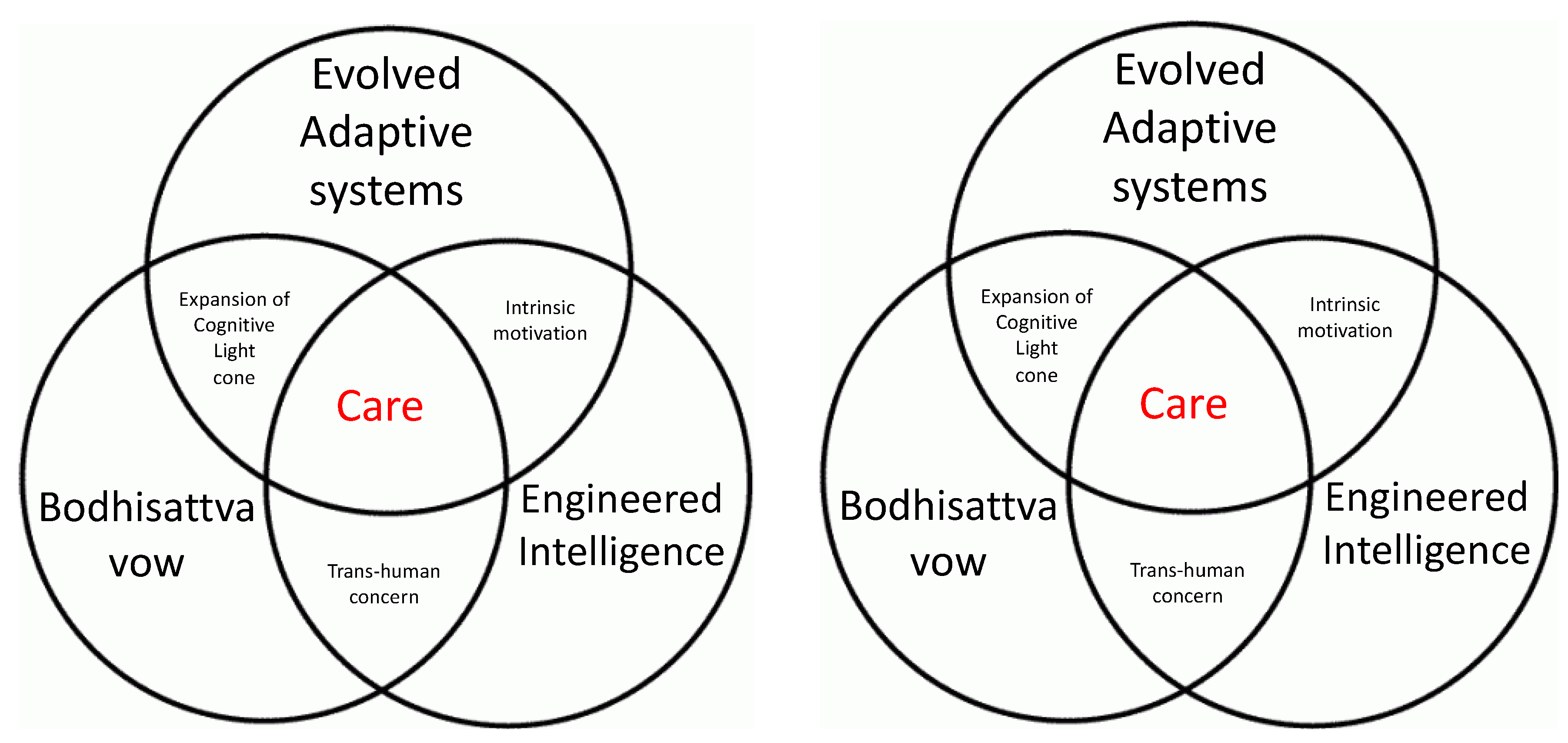
The more chains of negentropy we can string together, the more wise our decisions. Michael Levin talks about expanding the “cognitive light cone,” the maximum goal state a system is capable of conceiving.
A cell’s cognitive light cone might extend to maintaining homeostasis and responding to local gradients. An animal’s might extend to finding food and avoiding predators. Humanity’s cognitive lightcone has expanded literally to the moon and beyond, technology is accelerating our collective intelligence capacities at breakneck speeds.
Expanding our goals necessarily means expanding what we care about. A system can only pursue goals it can represent, and representation requires investment: attention, energy, resources. The boundary of what we can conceive is also the boundary of what can move us to act. Goal-directedness and care are two sides of the same coin.
So along with scaling our “cognitive lightcone” we need to scale our capacity for Care: defined by Levin as the active exertion of energy toward preferred, ordered states.
This Care serves as the central invariant across all scales: in biology, it manifests as the homeostatic loops that keep a cell alive; in AI, it is the objective function that directs an agent’s focus; and in the Buddhist tradition, it is the Bodhisattva vow, a commitment to the welfare of all sentient beings.
By shifting from narrow, internal “metabolic” goals to an outward-facing concern for the goals of other agents, we effectively scale our cognitive boundaries. In this view, wisdom is the process of widening our circle of Care, moving from the survival of the individual organism to the preservation of the entire universal system.
But while our intelligence accelerates at breakneck speeds, our care/wisdom light cone is lagging. Our intelligence has become abstracted and "left-brained," favoring narrow logic over broad, embodied wisdom.
So as we accelerate our path toward greater intelligence I think we also need to take a step back and see how the entire system operates. Ask ourselves, do our actions make the world better for just ourselves? Or are we doing something that carries a negentropy benefit for multiple levels of this universe which is radically interdependent?
Gurdjieff used to advise that his students work along 3 lines at the same time, 1/3rd of their work energy should go to themselves, 1/3rd of their energy to their family/community, and 1/3rd to the great work itself.
If that sounds like a tall order, it absolutely is. However, it doesn’t have to be done all at once. One should work on themselves primarily until one has excess energy to pour into others and not before. It is like hierarchy of needs, you can’t meet others until you are met.
However, according to Gurdjieff there is a point where self-development stops developing, or at least slows, and that is the point where one must start putting energy out into the world instead of keeping it all for oneself.
The Integration Surplus
Wisdom selects goals that sustain harmony across scales. While intelligence maximizes a reward signal, wisdom questions whether that signal points toward anything worth wanting.
It may be that wisdom is an emergent phenomenon of a harmonized intelligence.
Philosopher Layman Pascal offers a framework he calls the “integration surplus model”:
“Enlightenment, whether as a temporary state or an ongoing stage, could be considered as the surplus numinous coherence resulting from the adequate integration of different forms of intelligence within us. Their resonant entanglement, whether caused by practice or circumstance, generates a Gestalt overflow that is more than the sum of the parts. And the result is a saturation of our entire perceptual and cognitive field with a meaningful blendedness.”
In a universe governed by the Law of Falling, our highest agency is to become conduits for the Law of Rising, integrating our knowledge until it overflows into a “meaningful blendedness” that we call wisdom.
This "blendedness" is negentropy made personal. When our scattered intelligences (rational, emotional, somatic) finally cohere, we stop leaking energy into internal friction and become capable of sustaining goals far beyond our individual survival.
“Leaking energy” by the way, is a metaphor that Gurdjieff used to describe how most of humanity squanders their daily allotment of energy. He used to say that we have more than enough energy to live a happy and fulfilled life but that most of our energy leaks, due to petty worries, negative emotions, and identification/attachment to outcomes.
As we gain coherence and internal order, we plug the leaks and get to keep more energy for ourselves. But coherence isn’t just cognitive. It must include the body.
Beyond the “Weak Yogi”
Crucially, this “knowledge” is not merely intellectual data or a collection of facts. It is also somatic knowledge: a deep, lived-in awareness of our emotions, sensations, memories, and intuition.
Without this embodiment, we risk becoming what Gurdjieff called “weak yogis”, who “know everything and can do nothing.”
In other words, what’s the point of knowledge if you can do nothing with it? Wisdom is the point where knowledge, goals, and behavior finally unite. It is the transition from knowing the Law of Rising to actually embodying it.
As we face a future of runaway artificial intelligence, our task is not just to be smarter, but to be more integrated, to ensure that our capacity to “do” finally catches up to our capacity to “know.”
AI is a brilliant servant but a hollow master. It has vacuumed up the world’s libraries, but it has no nervous system to feel the weight of the words. It lacks the 'gut feeling' of moral misalignment, the biological flash of surprise that triggers true transmutation. It can simulate the Law of Rising, but it cannot suffer the climb.
We can trust it to think but we must not trust it to be wise.
The Human Edge
The irony of AI is that it serves as a perfect mirror for our own current imbalance. It represents the ultimate “weak yogi”, it has effectively vacuumed up the world’s collective information, yet it possesses no nervous system to feel the weight of it.
It has no gut feeling to signal a moral misalignment, no biological “surprise” to trigger true learning, and no mortal heart to understand why time, family, or a specific plot of land actually matters.
It can simulate the logic of the Law of Rising, but it cannot embody it like we can.
As we move deeper into this singularity, the goal shouldn’t be to out-calculate the machines. We’ve already lost that race. The real work is in closing our own internal gaps, reconnecting the “left-brained” data we’ve accumulated with the somatic, embodied wisdom that actually allows us to do something with it.
Gurdjieff’s 1/3rd rule is a good place to start. If we spend all our energy on the “intelligence” of the digital ether, we neglect the very container that allows that energy to rise. In a universe that is naturally descending into disorder and falling apart, our highest agency isn’t found in knowing more facts.
We must become the connecting point that fuses knowledge with action, plugging the leaks in our personal and collective systems so that energy stops escaping and starts flowing toward goals that maximize care.
Thank you, it’s awesome 🙌🏼👏🏼
❄️