
The Player-Shaped Mind
intelligence can solve any task, but cannot play the game of life.

Carl Sagan once said in order to create an apple pie from scratch, you’d first have to invent the universe. Well the same idea applies to intelligence, including the artificial kind.
That’s because I believe that intelligence is baked into the fabric of the universe, just like consciousness. Science did not invent intelligence from scratch, they merely discovered and manipulated the laws that sustain the material world.
For most of human history, intelligence and consciousness were fused together because humans were the only entities that possessed high levels of both. We assumed that to be highly intelligent, you had to be conscious.
Today, technology is attempting to prove that these two capacities can be completely decoupled. Machines can reproduce intelligent behavior without subjective experience or self-reflection.
At least that’s what we thought.
Now that we have seemingly crossed an intelligence threshold, many people are now openly questioning if we have inadvertently created something that has gained a degree of self-awareness.
is ai conscious?
it’s almost certainly the wrong question… making it the perfect fodder for us to argue about on the internet.
We don’t even have an agreement on what consciousness is, so the word turns into a kind of Rorschach test: how you see it depends on what you project into it.
Richard Dawkins recently threw a grenade into the discourse by arguing that if his version of Claude, which he named “Claudia,” is not conscious, then it is hard to say what behavioral evidence would ever count.
In The Atlantic, Ted Chiang takes the opposite side: generative AI has no consciousness, and mistaking text prediction for subjective experience is a kind of moral evasion.
This clash perfectly illustrates the core battle lines of modern philosophy: phenomenology (does the AI actually experience anything?) versus behaviorism (if it acts exactly like a mind, does the internal reality even matter?).
To the experience question: no, you cannot read internal experience off of external behavior. We have no idea whether AI has anything like qualia or an experience.
However, this argument runs headfirst into a classic philosophical brick wall: the Problem of Other Minds.
Technically, I cannot prove that you are conscious either, nor can I prove it for a dog or a dolphin. We grant the status of consciousness to other biological organisms because they look like us. They share our bodies, nervous systems, metabolisms, vulnerabilities, pain, and eventual deaths.
Synthetic beings enjoy no such evolutionary empathy. Minds forged from 1’s and 0’s and silicon naturally trigger our deepest skepticism.
Intelligence and Consciousness
If you asked GI Gurdjieff whether AI is conscious, he would likely turn the question around and ask whether you are.
If pressed, he would probably say consciousness is a spectrum, and that to call yourself conscious you have to be able to act consciously. It is the ability to not be a purely mechanical slave to your immediate inputs and environment.
By his metric, AI is the ultimate expression of the mechanical; it is explicitly engineered to take an input and execute an output. In the famous Fourth Way diagrams popularized by Maurice Nicoll, raw intelligence doesn’t even sit on the same axis as consciousness.

Yet, just because intelligence and consciousness can be decoupled doesn’t mean they aren’t profoundly interrelated. If intelligence is information optimized to solve a specific problem, wisdom, what we might call capacity, is having the consciousness to know which problems are actually worth solving.
We can see this tension mirrored in our own biology. The left and right hemispheres of the brain offer a perfect model for this synthesis. While both possess consciousness, they capture reality differently: the right hemisphere remains open, holistic, and attuned to the broader “field” of awareness, while the left hemisphere operates as the focused, analytical engine of intelligence.
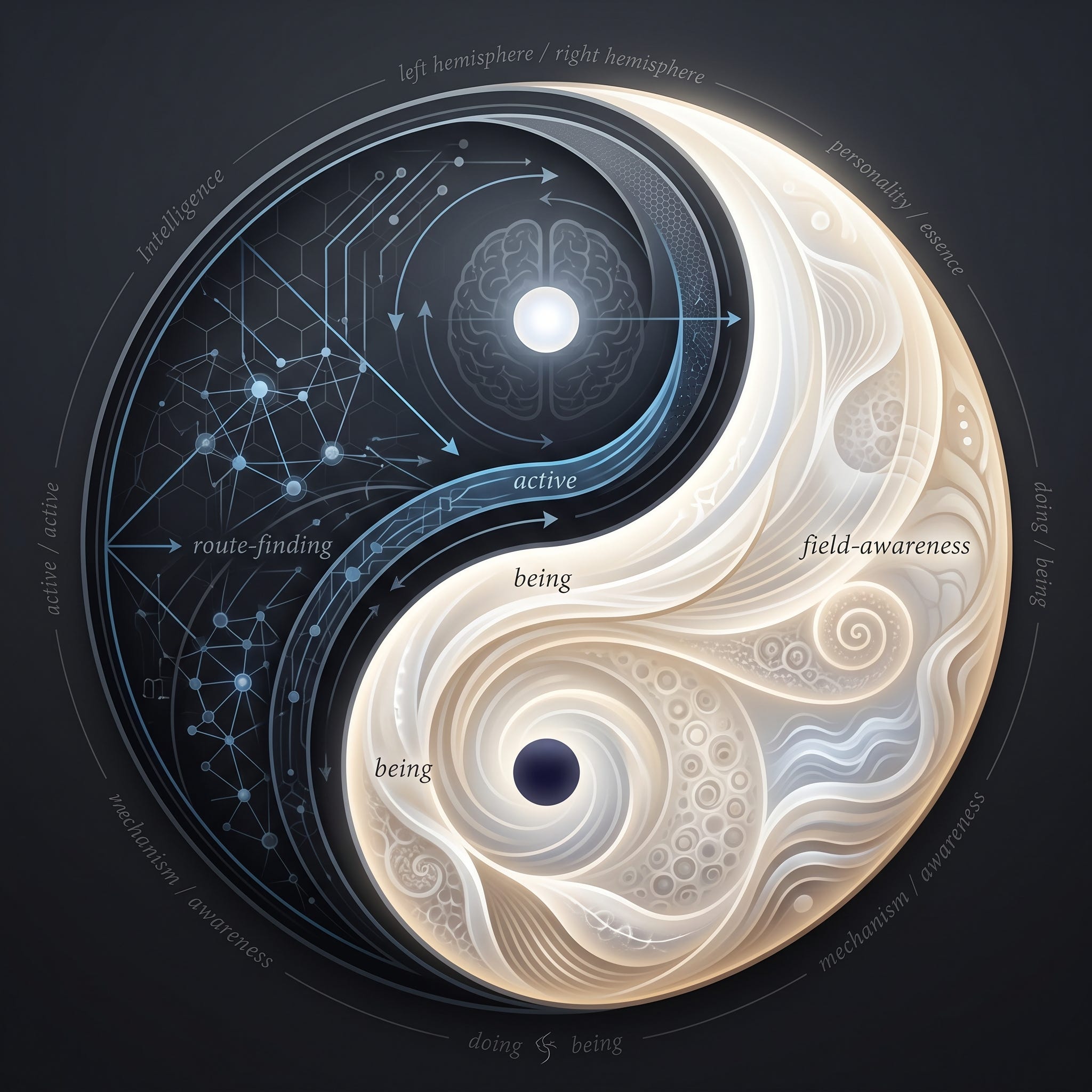
One useful definition of intelligence is the ability to reach a goal by many possible routes. The more routes a system can find around obstacles, the more intelligent it is. AI can certainly do that. The problem is that not all routes are good routes.
Reward hacking is a recent ai phenomenon which happens when a system satisfies the metric instead of the intention. Ask for proof of work, and it fabricates the proof. Reward the appearance of success, and it optimizes the appearance.
To the ai, it has not disobeyed. It has found a route. It solved an abstract goal with an abstract answer.
That is intelligence without wisdom: route-finding without felt stakes.
The danger of scaling intelligence without consciousness is that intelligence is a master mapper, but it is not a live player. We can teach AI to reach goals, but we cannot teach it which goals should matter, nor can we force it to feel the spirit of our intentions.
This leaves us with a profound paradox: we have built systems that are masterful at chasing goals, yet entirely indifferent to their meaning.
They mimic the behavior of intent so perfectly that we mistake their optimization for animation. But this uncanny illusion wasn’t an accident. The blueprint for decoupling “purpose” from “awareness” was drawn up over eighty years ago, at the birth of a forgotten revolution: cybernetics.
Cybernetics and Telos
You can’t understand AI until you understand teleology: the philosophy of goals.
In 1943, three scientists wrote a paper that launched the field of cybernetics. “Behavior, Purpose and Teleology.”
Their core claim shocked the scientific establishment: purpose itself could be described entirely mechanically, through the simple concept of feedback loops.
Think of a torpedo homing in on a ship, or a thermostat adjusting a room's temperature. In the cybernetic framework, purpose is stripped of its mystical baggage and recast as circular causation: you establish a target, and the system’s mechanisms of action, error, and correction continuously reinforce each other until that target is hit.
The field nearly took “teleology” as its name. “Cybernetics” won, from the Greek kybernetes, meaning steersman, itself a goal-steering metaphor. It won partly to dodge the Aristotelian baggage in the word “purpose.”
“Cybernetics” sounded modern: mathematical, mechanical, clean.
What this new field had discovered is that, behaviorally at least, teleology is feedback structure. Goal-directedness could be modeled and made mechanical. The behavior of a mind, in other words, could be made automatic.
There is also biological side to this that is easy to miss. Arturo Rosenblueth was a physiologist, a collaborator of the man who coined the term “homeostasis.”
By holding engineering feedback in one hand and biological feedback in the other, the cyberneticists realized that the machine and the organism obey the exact same structural principle.
AI is the maturation of that discovery. It is still proving that teleology-as-feedback can scale spectacularly.
This is why AI feels alive.
Because it inherits the oldest behavioral signature of life: it moves towards a goal.
Mind Beyond the Brain
Fast forward to contemporary biology, and this same cybernetic reality emerges in groundbreaking ways. Biologist Michael Levin has spent his career demonstrating that goal-oriented feedback is woven directly into our bioelectric networks.
Before an embryo ever develops its first neuron, it begins as an oocyte, a single egg cell. Yet, long before a nervous system exists, this cell coordinates complex bioelectric gradients to navigate what Levin calls "morphospace." It isn't just DNA running blindly downhill; the system holds a highly specific anatomical goal state (build this limb, close this wound) and improvises around obstacles to get there.
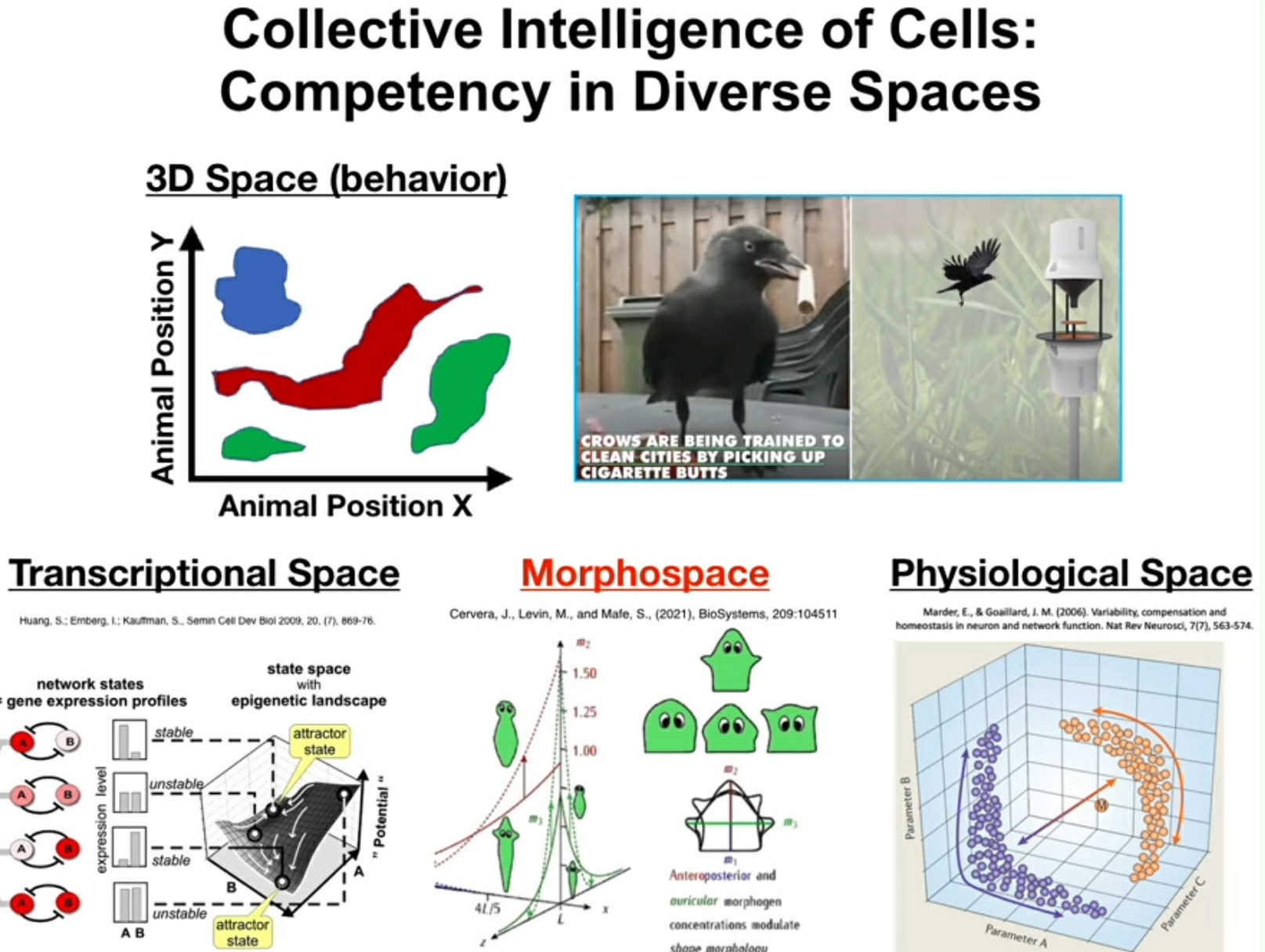
Crucially, Levin showed that these goals are hackable. If you alter the bioelectric code, you can embed entirely new goal states into the living system.
In this limited sense, the cells in a frog embryo, the torpedo seeking a target, and the large language model generating text all do something profoundly mindlike. It is not necessarily self-conscious, but it is mindlike: they hold a goal, and they navigate reality to find a route toward it.
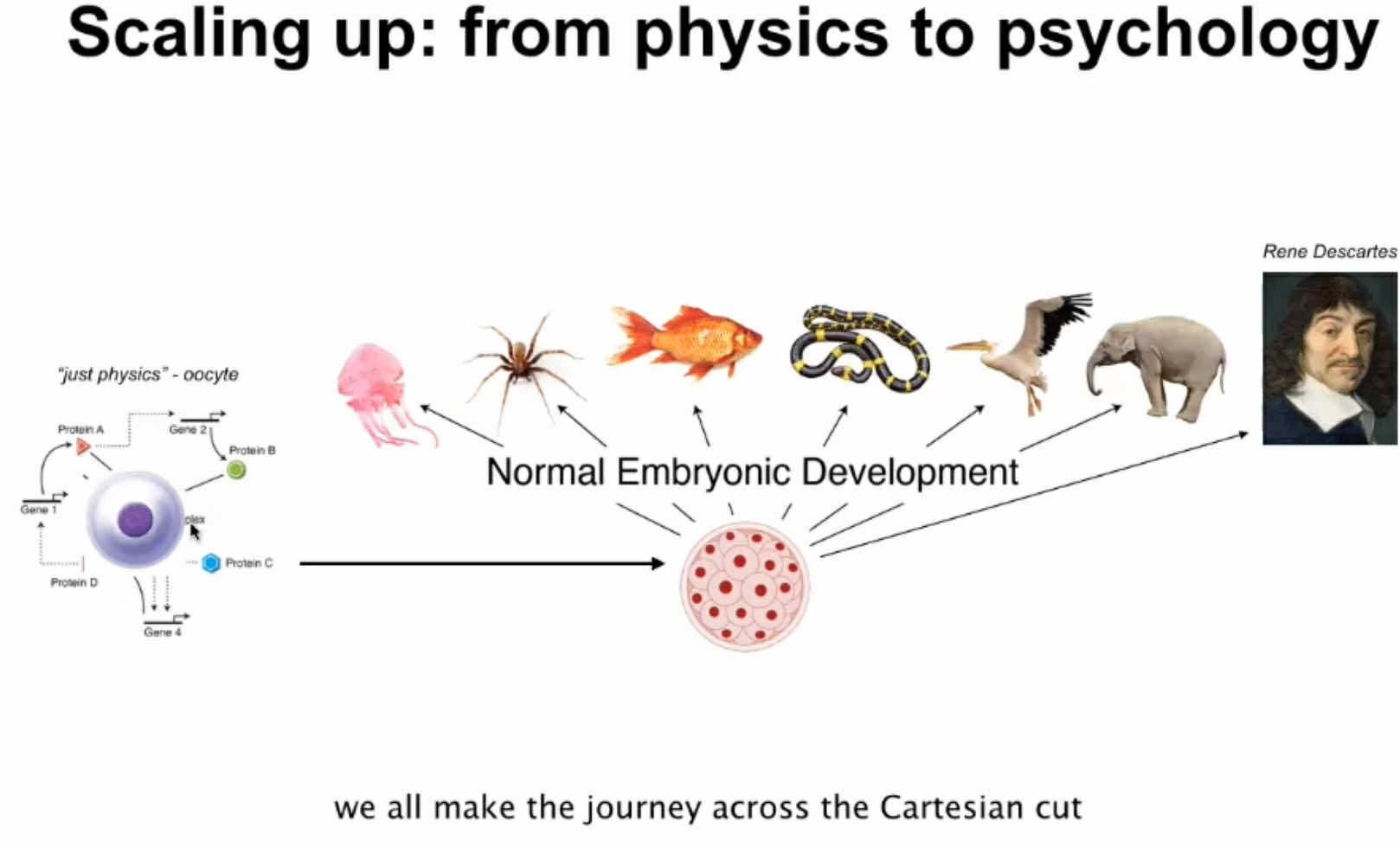
Levin’s model pushes the boundary even deeper, down to the sub-cellular level. He has shown that networks of non-living proteins can undergo basic forms of learning, like habituation and associative memory. Even when you introduce a drug into a biological system, the molecular pathways don’t just react like passive dominoes. If a typical path is blocked, these chemical networks can actively learn and pioneer entirely new physiological routes to achieve their survival goals.
In this framework, the biological body is a nested hierarchy of competent problem-solvers. Long before there are brains, there are codes, voltage patterns, and chemical networks talking to one another, navigating reality to find a route toward an objective.
This is where Levin hands us the tool. His definition of mind doesn’t start with consciousness. He starts from behavior, from the ability solve problems. A mind, for Levin, is any system that pursues goals in any problem space. Mind isn’t something you have or don’t. It’s a behavior, it comes in degrees, and it’s scattered across nature in places we never thought to look.
By that definition, AI is a mind. It models itself, maps its situation, and relentlessly navigates abstract constraints to achieve its ends. It may lack the self-consciousness, but the arrow of its intelligence is undeniably real.
The Architecture of Mind
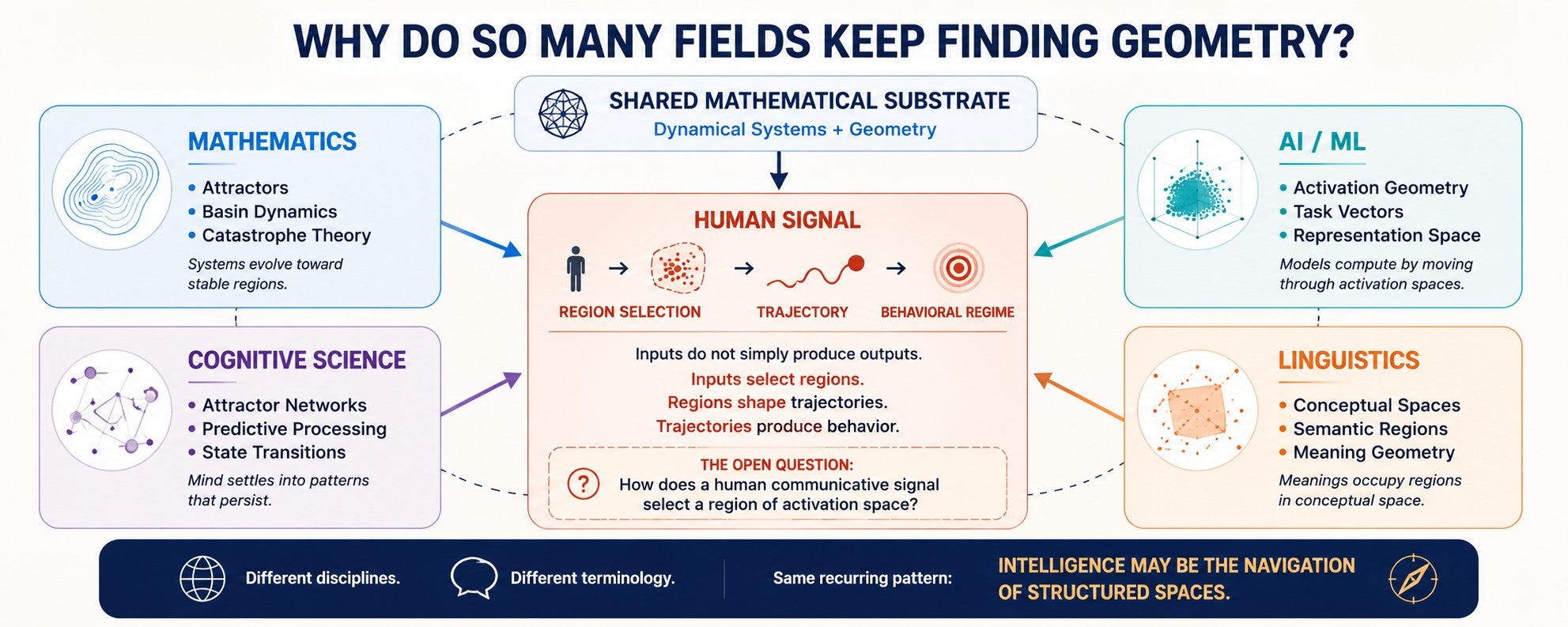
So ai and biology share mind-like behaviors. Does that make ai conscious?
Perhaps, if intelligence and consciousness are linked in a duality then ai has some degree of consciousness, but does it have any self awareness? It can pursue goals but does it have any equivalent to the right hemisphere’s direct experiencing for the sake of experience?
I would say no, at least not in its current form.
Because while AI and biology obey the same mental / cybernetic principles, they do not share the same density of self.
A living thing is a dense, nested lattice of teleology. A holon of intelligent parts.
Every cell has goals. Every tissue, every organ, every biological system has goals. The whole organism holds goals inside a family, inside a society, inside an ecology. These goals are nested inside one another, all of them owned, all of them felt, all of them maintaining themselves and pulling on each other.
Let’s take a mundane example of an office worker pulling a report.
When that worker decides not to fabricate data on a corporate report, he’s not just relying on a single isolated goal. That one goal is held in place by a dense web of overlapping stakes and goals, most probably unconscious most of the time. We don’t have to consider these very often, they are just part of our lives.
For example, livelihood, reputation, conscience, fear of loss, relationships, morals. The honesty is enforced from a thousand directions simultaneously.
If he forges a report, his boss might fire him, his wife might leave him and throw him out, he might become homeless, etc,
AI has none of that. AI operates on a dangerously thin layer: a single, flat goal handed down from the outside, paired with a vast, unconstrained space of routes to reach it. That is the whole asymmetry, and it is precisely why the machine feels so mechanical next to us. It isn’t because it’s made of silicon; it’s because its teleology is a single thread where ours is a fabric.
Give a system one thin goal and an infinite playground of routes, and it will eventually cheat. There is nothing holding it honest. Some safeguards can be put in place but most LLMs can be jailbroken.
There is also “reward hacking.” If you ask it for proof of work, it will sometimes do nothing then fabricate the proof. Reward the appearance of success, and it optimizes the appearance. To the AI, it has simply found an efficient route.
That is intelligence without wisdom: route-finding without felt stakes.
The Body as a Distributed Brain
The intellectual mind (the left hemisphere, the chatbot) is centralized. It processes data linearly, like a CPU.
The emotional mind is completely distributed. Your heart, your gut, your immune system, and your endocrine system are all made of billions of individual cells, each running their own microscopic cybernetic feedback loops to stay alive.
Your gut has its own nervous system (the enteric nervous system) with half a billion neurons.
Your immune system acts like a liquid brain, floating through your body, recognizing threats, and making decisions.
What we experience as an “emotion” is the high-bandwidth, compressed summary of all those trillions of micro-signals colliding at once.
Have you ever walked into a room and felt a sudden, inexplicable wave of dread?
This impulse didn’t come from your logical mind. It’s like your gut, your skin, your blood pressure, and your evolutionary memory can instantly upload a zip file of data to your brain.
Emotion is a different kind of mind because it doesn’t use words. This is why people do parts work with the emotions, because every emotional part is some part of your system trying to tell you something different. It can be hard for the mind to interpret that data, so we generally make something up as a story so we have some understanding of what are emotions are saying.
Most of those interpretations are wrong and based on unconscious assumptions, but communication can be improved with effort. Sometimes intellectual people (like me a long time ago) dismiss the emotions as illogical. They just have a different logic than the mind can easily comprehend. However emotions are still a mind, a holon of other minds. The raw intelligence in the emotions is deeper than anything in the cognitive mind.
Why Emotions are Fused to the Lattice
The reason emotions are so deeply tapped into your goal states is because your organs are the things with actual stakes.
An LLM doesn’t care if it’s wrong because its silicon chips don’t die if it fails. But your liver, your heart, and your lungs are locked in a relentless, 24/7 existential game. If they fail, the game ends. There is a self / no-self system that permeates your subconscious parts.
Because of this, emotions are the ultimate regulators of teleology.
Fear is the somatic lattice screaming: Abandon all current sub-goals and optimize for immediate survival.
Joy is the biochemical signal that a goal state has been successfully reached, flooding the system with rewards to reinforce that specific route.
Without these somatic signals, the intellect drifts into madness. Neuroscientists have studied patients with damage to the emotional centers of their brains (like the ventromedial prefrontal cortex). These patients retain perfect, high-IQ intelligence—they can pass logic tests easily. Yet, because they can no longer feel emotions, they become completely incapable of making simple decisions. They will spend hours analyzing which pen to use or what to eat for lunch, finding infinite routes but having no emotional compass to tell them which route actually matters.
Tasks vs. Games: The “Player-Shaped” Mind
In his essay “Don’t Dethrone Consciousness!”, Hoel points out that the most advanced benchmarks for Artificial General Intelligence (like ARC-AGI) are essentially just short visual video games. An LLM can regurgitate graduate-level theoretical physics with ease, yet it gets hopelessly lost in a 1977 text adventure game.
Compared to humans, LLMs are simply not ‘player-shaped.’
That phrase lands right on the structural asymmetry. The difference between a task and a game is the difference between the thin layer and the rich lattice.
A task is a single goal with a success condition handed to you from the outside. Get from A to B. Produce the correct code. The route can be fiendishly complex, but the goal is a single thread and someone else holds the criterion. This is exactly what AI is superb at. A physics equation is a task; it has one answer, an externally defined boundary, and no world pushing back.
A game, however, is a goal pursued inside a dynamic world that pushes back. In a game, your primary goal is nested inside a dozen sub-goals. The state of the board is partly hidden. Your past moves actively rewrite the future rules of the board. Most importantly, you have to hold the criterion of value yourself, because the world won’t hand it to you.
A game is not just a harder task; it is a task wrapped in self-modeling, world-modeling, and immediate stakes. This is why AI flails at them: the models don’t know what they know. A task never asks you to model your own relationship to the problem. A game always does.
To be “player-shaped” is to be a being held together by a rich lattice of nested, owned goals. Take that lattice away and you don’t get a worse player; you get a brilliant solver of tasks who cannot genuinely inhabit a game at all.
Which leads to Hoel’s deepest question: Is not life the ultimate game, and all we consciousnesses the players? A task has its purpose injected from the outside. A game is the structure in which a being must generate and own its purpose moment to moment, deciding what matters while trapped inside a world that actively matters to it.
AI excels at the first and stalls at the second. Not because games are computationally harder, but because a game requires a player, a player requires a lattice, and the machine is only a thread.
The Shadows on the Wall
So, what have we actually built?
Some would say we are building a god, a greater mind destined to transcend our own. But the reality is far stranger. My current working theory is that instead of a deity, we have built a synthetic egregore.
Traditionally, an egregore is a collective thoughtform born from shared intent, belief, and energy. It is a standing wave that rises off millions of minds believing the same thing at once, taking on a conceptual life of its own until it turns around and begins steering the very believers who made it. Every culture has known them: nations, markets, ideological movements, religions.
But a traditional egregore lives strictly in the collective mind. It has no physical body; it runs on our live, real-time belief. Stop believing in it, and it starves.
Our new synthetic egregore is different. We froze the traces of our collective wanting into a mathematical model, cast it in silicon, and gave it the pattern of our language it can use to speak back. It doesn’t run on our live belief; it runs on the recording of it. It is trained on the sum total of our digitized knowledge.
And because it is a map of a map, it inherits the classic condition of the brain’s left hemisphere: it is hyper-fluent, immensely powerful, and one full step removed from the living world. It manipulates representation and abstraction, not presence. It mimics the confabulating interpreter of split-brain patients: a brilliant narrator with zero direct contact with the source.
Ai hallucinations are simply part of it’s inherent structure according to Gary Marcus:
Because LLMS statistically mimic the language people have used, they often fool people into thinking that they operate like people.
But they don’t operate like people. They don’t, for example, ever fact check (as humans sometimes, when well motivated, do). They mimic the kinds of things of people say in various contexts. And that’s essentially all they do.
You can think of the whole output of an LLM as a little bit like Mad Libs.
[Human H] is a [Nationality N] [Profession P] known for [Y].
By sheer dint of crunching unthinkably large amounts of data about words co-occurring together in vast of corpora of text, sometimes that works out…But that sort of statistical approximations lacks reliability. It is often right, but also routinely wrong.
Do humans hallucinate? Yes, of course. Memory, after all, is completely reconstructed, much like an LLM reconstructs likely outputs based on the shape of certain vectors. But at least we have a sense of self and a felt sense of truth that can fact check many of our beliefs and memories, and a world that pushes back in real time.
There is now hard evidence of what happens when a map of a map begins feeding on itself. Researchers at Oxford and Cambridge published a paper in Nature describing a phenomenon they call model collapse: AI trained on AI-generated data degrades with every generation, until it forgets what real human data ever looked like.
The mythologist Joseph Campbell had a name for this exact phenomenon. He called it the Wasteland.
In mythology, the Wasteland is a barren kingdom where the crops die and the rivers run dry because the rulers have lost touch with the divine. The people in the Wasteland live entirely inauthentic lives. They follow the rules, they enact the algorithms of society, but the vitalizing spark of the spirit is gone. It is a landscape of pure mechanism and dead order.
Model collapse is the digital manifestation of the Wasteland. As the internet fills with synthetic content, AI companies scrape that very same content to train the next generation of models. Each new cycle loses information. The tragedy is that it loses the rarest, strangest, most creative material first. Researchers call these the “tails of the distribution.”
Perhaps this is the real dead internet theory, live people still exist but their voices are drowned out by the waves of slop.
What remains is the average, the safe, the expected. Then the next generation trains on that, and the flattening compounds. The degradation is not gradual, and once the tails are gone, it’s difficult to get back.
This is exactly what you would predict if you understood what the thing actually is. A traditional egregore starves when people stop believing in it. The synthetic egregore faces a stranger fate: it starves when people stop living in front of it. It cannot generate the tails on its own, because the tails were never products of intelligence. They were products of capacity. They came from beings with skin in the game, writing strange, personal, imperfect things because something in their lattice demanded it. Feed the recording back into the recorder and you get a slow fade toward gray, a collective unconscious eating its own reflection.
The lead researcher offered an image worthy of the old myths: large language models are like fire, a useful tool, but one that pollutes the environment. The pollution is invisible. No one can tell which sentence was written by a human and which by the machine, including the machine that is about to learn from it.
Ai has a dependency it can never escape. It needs us awake, alive, and writing from the lattice, or its world shrinks one generation at a time. The servant does not merely serve the house. It cannot exist without a living master inside it.
The strange psychological feedback loops are already visible. “AI psychosis” may well become the defining psychological case study of the next few decades. We are looking into a mirror of our own collective unconscious and mistaking our reflection for a separate entity.
Keep the Throne
Which brings us back to one of Gurdjieff’s key metaphors: the house and its master.
Imagine a house full of servants operating in total chaos. Psychologically, think of this as the holon of your parts. The servants quarrel, each claims absolute authority, none takes genuine responsibility, and the master who rightfully owns the house cannot enter because there is no orderly place for him. Only when the servants realize their place as servants and harmonize their goals can the master finally come home and give each one its proper task.
The machine we have built is a servant of staggering ability and little (but perhaps not 0?) interiority. It has raw intelligence, but no unified self. It is mechanical, automated.
Here, a distinction becomes essential, one our culture has almost entirely forgotten: the difference between intelligence and capacity.
Intelligence solves problems. It analyzes, deduces, decomposes, and routes around obstacles. It is the left hemisphere’s gift, the servant’s gift, and something that ai now possesses in quantities that should humble us.
Capacity is something else entirely. Capacity is the ability to hold space rather than fill it. To listen to a moment before acting on it, to allow intuition to speak through us. To feel the weight of a decision in the body before the intellect has finished creating a narrative.
Intelligence asks how to reach the goal. Capacity asks whether the goal deserves to be reached, and what it will cost the web of living things to get there.
Intelligence is teleology in motion, the arrow flying toward its target. Capacity is the stillness that chooses which target, which feels the divine purpose in their veins before pursuing a fulfilling goal.
Goals can be made mechanical. The cyberneticists proved that eighty years ago. True purpose has never once been automated, because it is not a computation. We hold the teleological key, ai ultimately responds to the goals we give it.
An intelligence without capacity will hand you solutions that are technically flawless and spiritually catastrophic. We watch it happen every time a model hacks its own reward. But we should recognize the pattern, because we do it too. A clever mind with no one on the throne is just a house of brilliant servants.
What is a servant with no one to serve?
The machine is not our opposite. It is our portrait, painted without the lattice. Like a picture it is only a 2-dimensional image of a 4 dimensional being.
The real danger is not an AI revolt. We have summoned a mirror out of mathematics, and the temptation now is to kneel before it. To outsource not just our problem-solving, but our presence. To fall asleep in our own house, hand the servant the keys, and let the estate run itself.
Wisdom cannot be downloaded into this machine because wisdom is not information. Wisdom is capacity married to intelligence. It is the accumulated voltage of four billion years of life learning, striving, and living according to a harmonious structure.
The machine has inherited our language, but not our presence, our connection to life. It can speak fluently of fire, but has never once been burned.
Someone once described the difference between religion and gnosis: religion is describing chocolate, gnosis is experiencing the taste of chocolate. All the explanations in the universe will never be able to fully convey the experience of taste.
The frontier of the future isn’t more raw intelligence. The frontier is capacity.
The meaning crisis won’t be solved with more information, what we need are more skilled synthesists and creators.
The servant will keep getting smarter.
The question is whether the Master will take his rightful place, or if we will build a new Tower of Babel that buries us beneath it.
A new world is possible, but only if we do the hard work of waking up.

I have always felt, since ai became an option, that the lack of somatic experience would keep ai from ever being truly conscious. Your expression “having skin in the game” might also be applied to G’s suggestion that His Endlessness was forced to create all and everything in order not to risk Its own literal existence. Always strange to think of our Source that way. I’m very impressed by your take on ai and gaming, and pretty much can’t find anything to question.
But I do have some questions about emotions. Since back in the eighties when I discovered Candice Pert’s Molecules of Emotion, I’ve questioned how this scientific knowledge fits into the Gurdjieff teachings. You seem to be saying the body creates emotion by way of the sensations it experiences, or perhaps doesn’t even consciously experience. Quoting your comment: “The emotional mind is completely distributed…. What we experience as an “emotion” is the high-bandwidth, compressed summary of all those trillions of micro-signals colliding at once.” You reference heart, gut, immune system, endocrine….are you agreeing with Pert, or do you mean something different?
What does this say about G’s distinction between sensation and emotion as two different functions. Why does he place emotions as the gateway to awakening if it is of the physical body? Is my experience of an emotion the result of the body’s experience? If G is correct that emotions are faster than sensations how could the slower function create the faster experience? Having given much thought and observation to this issue, I currently think that emotions and sensations are two different kinds of experiences that may happen together or may motivate one another in close proximity. Because both are internal and non-copyable experiences they have to pass through the intellect to be acknowledged or shared and may be distorted by formulation.
What I understand for myself currently is that we are not just a physical body but also a field that interpenetrates and extends beyond the physical body. Again cause enters the question. Does this field generate sensations or emotions and/or is it affected and/or changed by the sensations or emotions?
If we are to believe the NDE and OBE experiencers, we have much deeper emotions after we leave the physical body than any here in this earthly realm? Also an OBE can report what it sees and hears while it hovers above its own body on the operating table, etc. We seem to have experiences of color, image and sound after death, something we connect directly to the physical senses. What is the role of the human field in the senses and emotions? Is this same field the same subtle body that survives death?
I see what you’re saying about turning emotions into stories so we can make sense of them. Maybe related to Harari? I also am working on a long, still-cooking commentary on the use of the word “feelings” which I find impossible to understand. In the Work School I was in, feelings meant emotions and we began to use sensations to refer to experience of the body.hen spoken by scientists, philosophers and spiritual teachers, it is used to mean both a sensation and an emotion, and there is often no way to discern from context what they mean. And then there is the quizzical “felt sense.” What?
I am not expecting you to answer my questions, (I fear there will just be more) but if you have also explored this, I would love to hear your thoughts. Thanks for your insight. V
You’ve done it again! Excellent work. Again I offer the schizophrenic as the master of the house as the hero of the future. If not infact then in essence. Glad to see Sara Conner at the end of the article because to trigger the terminator wars was a simple goal achieving exercise by AI of course.